
Quick project answer
Stage lighting changes how any surface reads. When a school auditorium partition finishes lighting scheme is selected, the finish can affect glare, contrast and visual calm across the room. This article compares finish considerations for top-hung movable partitions without claiming photometric values or universal outcomes.
Why school auditorium partition finishes lighting matters
Auditorium lighting is rarely uniform. Stage wash, side light and house light can meet at different angles. A finish that looks quiet under one condition may appear brighter under another. The goal is to compare samples under the lighting states the room will actually use.
For school auditorium partition finishes lighting, the finish is part of the visual environment, not a separate decorative layer. Coordinating finish review with lighting review helps the project team understand how panels will read when the room is divided or combined.
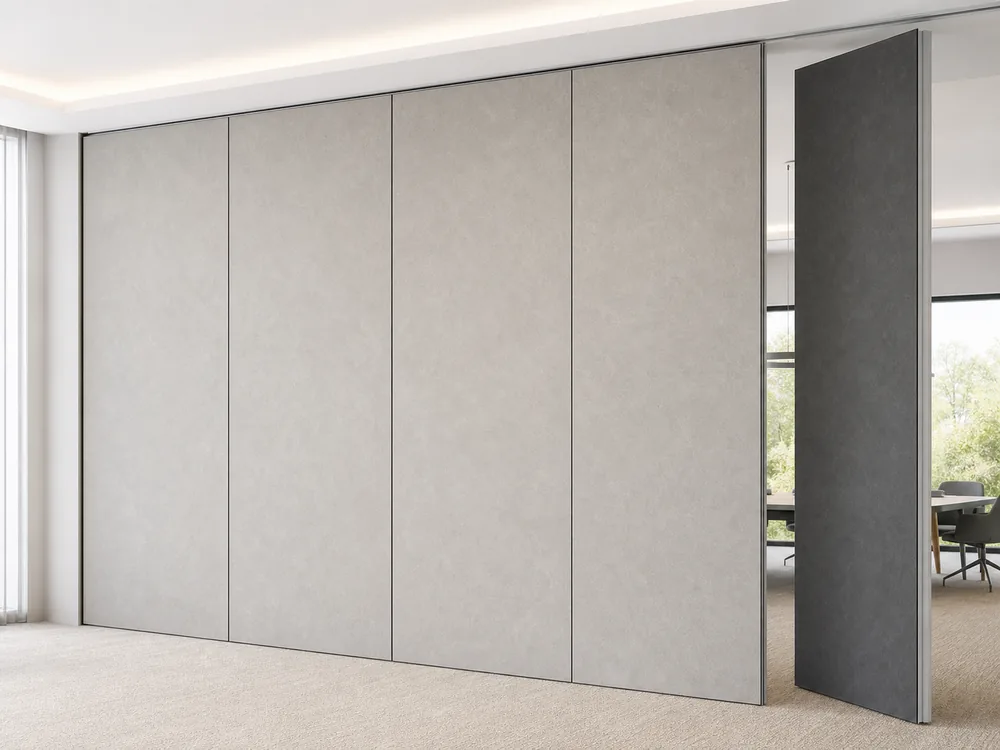
The top-hung principle and the floor line
The EBUNGE movable partition system is top-hung. It has no continuous floor running track or operating hardware in the finished floor along the partition line. The floor is not cut or damaged for a floor track and remains physically uninterrupted by the maintained EBUNGE top-hung system.
This matters for finish comparison because the floor plane stays continuous. There is no floor track to interrupt flooring transitions or stage-edge details. The partition line is defined overhead, while the finished floor remains a single visual field.
The exact route, junction arrangement, continuous overhead path and parking position must be confirmed from the coordinated project drawings.
Finish reflection under stage and house light
Finish reflection is not a single number. It depends on surface texture, color, angle and the lighting position. A matte-looking sample can still show a bright band when a stage light strikes it at a low angle. A darker sample can reduce contrast but may change the room’s visual weight.
When comparing school auditorium partition finishes lighting, review samples at the same distances and angles as the audience view. Check how each finish reads when the room is open, divided and in transition between uses.
Finish materials can be customized, and cleaning and maintenance methods vary with the selected finish. That means reflection review and care review should happen together, not in separate phases.
Parking planning and finish protection
Panel parking style can be customized to the customer layout and project requirements, subject to coordinated drawings. A suitable approved parking arrangement can use the stacking area more compactly and coordinate with the space design. The exact track, support and panel layout still require project drawings.
Parking location affects how finishes are seen in daily use. If panels stack in a visible area, their finish becomes part of that view. If they park away from the stage, the finish review may focus on the divided-room condition instead.
Use the following checklist when comparing finish and parking options:
- Review finish samples under stage light, house light and mixed light.
- Confirm where panels will park and how that area is seen from audience seating.
- Check whether the finish care method suits the school’s available cleaning approach.
- Coordinate finish selection with the approved parking arrangement and drawings.
- Record which lighting states were used during sample review.
Finish care coordination for school use
Cleaning and maintenance methods vary with the selected finish. A finish that suits one care routine may not suit another. The project team should confirm the care method before finalizing the finish, because the same surface may be handled differently in a busy school environment.
For school auditorium partition finishes lighting, care coordination is part of visual consistency. If a finish is cleaned in a way that changes its surface over time, its reflection under stage light may also change. The approved care method should match the selected finish.
Compare finish samples under the same lighting states the auditorium will use, and confirm the care method for each candidate finish before selection.
Non-limiting application examples
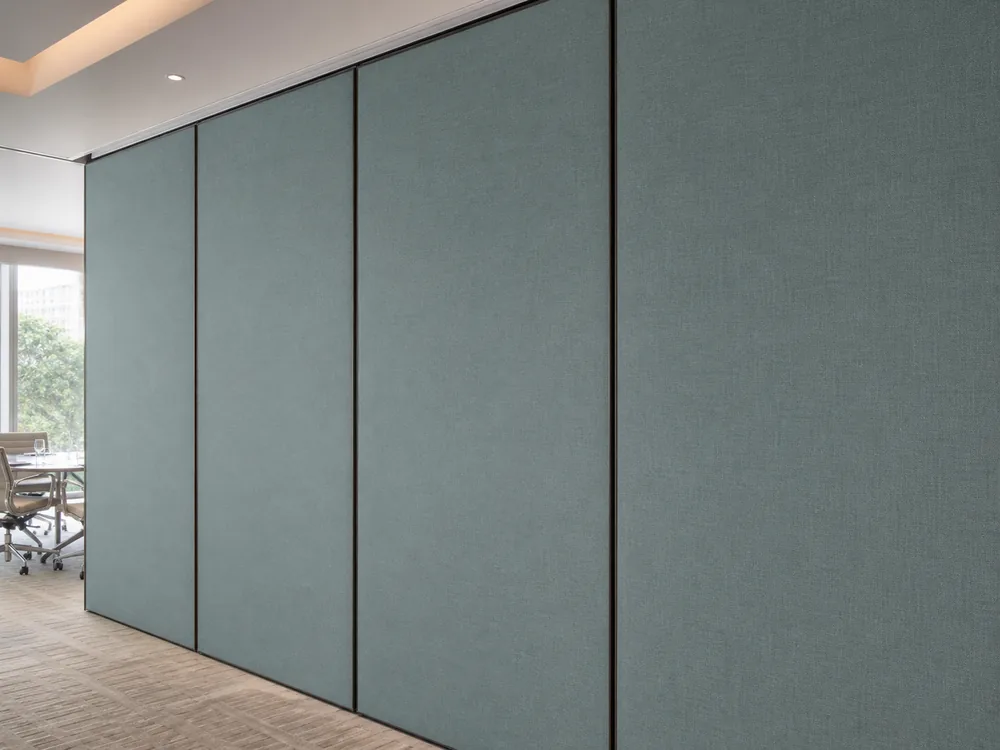
Movable partitions can be used wherever flexible space division, combination or reconfiguration is required; application examples are not limiting. EBUNGE has completed many types of hotel-related movable-partition projects; ballrooms, wedding halls and multifunction halls are non-limiting examples.
The exact overhead route and support arrangement must be confirmed by the responsible project team from coordinated drawings. The finish comparison should follow the room’s lighting and care conditions rather than a fixed product list.
Review the movable partition wall page for system context and the projects page for completed work examples.
Buyer inputs for finish comparison
A useful finish comparison starts with buyer inputs. The project team should provide the lighting states, the audience viewing angles, the parking location and the intended care method. These inputs let finish samples be reviewed against real conditions.
For school auditorium partition finishes lighting, the buyer should also confirm how the room will be divided and combined. The finish review should cover both the open-room view and the divided-room view.
The exact route, junction arrangement, continuous overhead path and parking position must be confirmed from the coordinated project drawings.
Drawing approvals and finish sign-off
Finish selection and parking planning both depend on coordinated drawings. The drawings confirm the overhead path, the parking position and the panel layout. Finish sign-off should follow the same review sequence so that the selected surface is compatible with the approved arrangement.
Panel parking style can be customized to the customer layout and project requirements, subject to coordinated drawings. Finish materials can be customized, and cleaning and maintenance methods vary with the selected finish.
Before final approval, compare the finish sample under the agreed lighting states and confirm the care method. The suitability of each route and parking arrangement depends on the approved layout, circulation, ceiling interfaces and operating sequence.
Frequently asked questions
How do I compare school auditorium partition finishes lighting effects?
Review finish samples under the same stage, house and mixed lighting states the auditorium will use. Compare them from audience viewing angles and record which lighting states were used.
Does a top-hung partition require a floor track?
The EBUNGE movable partition system is top-hung and has no continuous floor running track or operating hardware in the finished floor along the partition line. The floor remains physically uninterrupted by the maintained EBUNGE top-hung system.
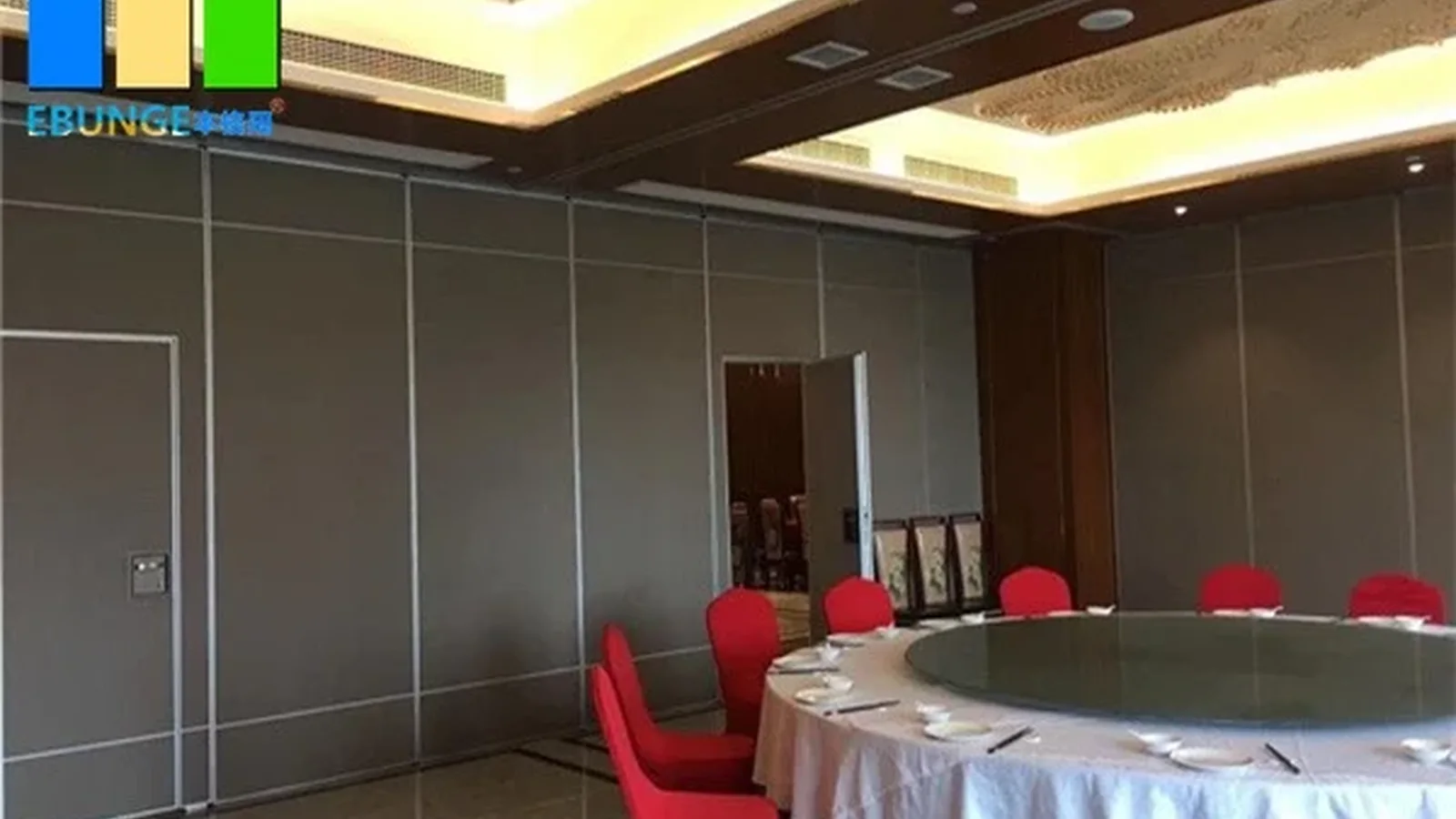
Can panel parking be planned around the room layout?
Panel parking style can be customized to the customer layout and project requirements, subject to coordinated drawings. A suitable approved parking arrangement can use the stacking area more compactly and coordinate with the space design.
Do finish care methods differ between finishes?
Finish materials can be customized, and cleaning and maintenance methods vary with the selected finish. The care method should be confirmed for each candidate finish before selection.
Are movable partitions limited to school auditoriums?
Movable partitions can be used wherever flexible space division, combination or reconfiguration is required; application examples are not limiting. EBUNGE has completed many types of hotel-related movable-partition projects; ballrooms, wedding halls and multifunction halls are non-limiting examples.
What must be confirmed from project drawings?
The exact route, junction arrangement, continuous overhead path and parking position must be confirmed from the coordinated project drawings. The exact track, support and panel layout also require project drawings.
Continue Exploring
More Materials and Finishes Guides
- Newer guideImpact Mapping for Sports Hall Partition Finishes
- Earlier guidePlanning Office Meeting Suite Partition Finishes: Chair Abrasion Mapping
- Related guideWho Verifies Partition Handover Records When Trades Finish at Different
- Related guideMovable Partition Finish Sample Coordination Guide for Interior