
Quick project answer
Exhibition hall partition finishes mobile display walls are a planning topic, not a catalogue choice. The finish you select affects how panels look, how they are cleaned and how they coordinate with the hall around them. This article explains the confirmed principles behind a top-hung movable partition system and the decisions that belong in coordinated project drawings.
Why exhibition hall partition finishes mobile display walls deserve early attention
In an exhibition hall, the partition line often doubles as a display background. The finish therefore influences both the visual field and the daily care routine. Because finish materials can be customized, the selection should be made alongside the parking plan and the room layout.
Exhibition hall partition finishes mobile display walls also affect how the hall reads when the partition is open. A consistent finish strategy helps the space feel intentional whether the panels are in use or parked. The suitability of each route and parking arrangement depends on the approved layout, circulation, ceiling interfaces and operating sequence.
The top-hung principle behind EBUNGE movable partitions
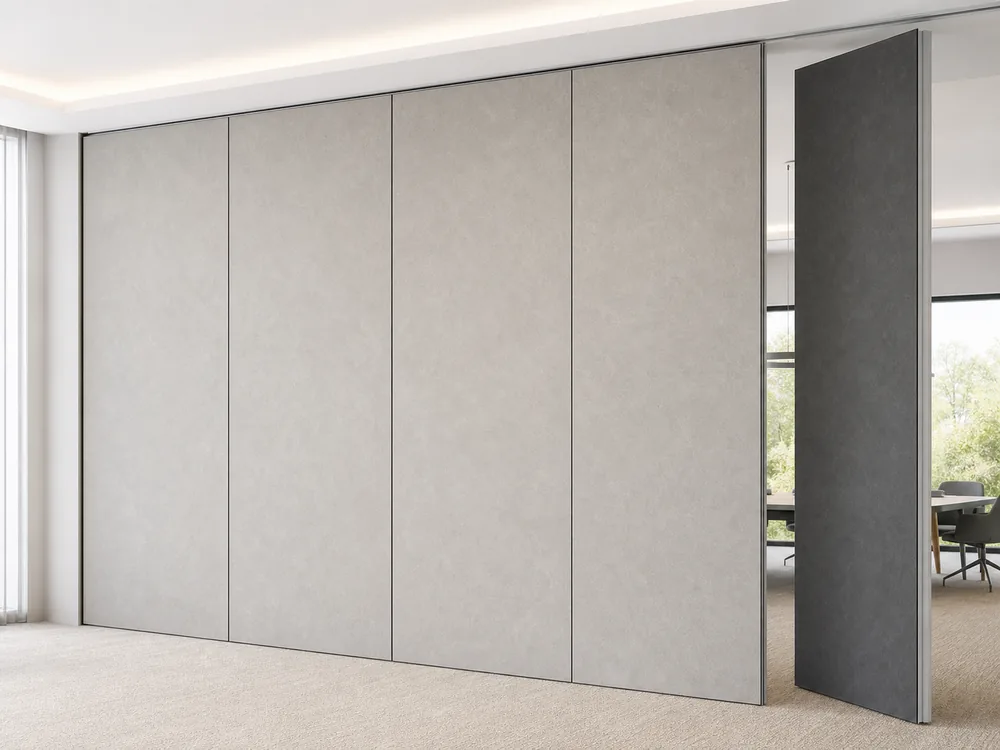
The EBUNGE movable partition system is top-hung. It has no continuous floor running track or operating hardware in the finished floor along the partition line. This is the central technical fact that shapes everything else in this article.
Because the system is top-hung, the floor is not cut or damaged for a floor track. The floor remains physically uninterrupted by the maintained EBUNGE top-hung system. For exhibition halls with finished floors, that uninterrupted surface is a practical planning advantage.
Movable partitions can be used wherever flexible space division, combination or reconfiguration is required. Application examples are not limiting. The top-hung principle applies across those uses, but the exact route, junction arrangement, continuous overhead path and parking position must be confirmed from the coordinated project drawings.
What a physically uninterrupted floor means for exhibition halls
A physically uninterrupted floor means no continuous track is embedded along the partition line. Visitors, staff and display equipment move across a surface that is not interrupted by operating hardware in the finished floor.
This matters for exhibition halls because floor finishes are often part of the brand experience. When the floor is not cut for a track, the finish can run continuously through the hall. The partition line remains a visual and functional division without becoming a permanent floor feature.
Exhibition hall partition finishes mobile display walls should be planned with this uninterrupted floor in mind. The finish of the panels and the finish of the floor can be coordinated as separate but related decisions. The exact route, junction arrangement, continuous overhead path and parking position must be confirmed from the coordinated project drawings.
Parking planning for mobile display walls
Panel parking style can be customized to the customer layout and project requirements, subject to coordinated drawings. A suitable approved parking arrangement can use the stacking area more compactly and coordinate with the space design.
Parking is not an afterthought for exhibition hall partition finishes mobile display walls. The stacking area occupies floor space, and its position affects circulation and display layout. Early parking planning helps the hall work as a whole.
The exact track, support and panel layout still require project drawings. The exact route, junction arrangement, continuous overhead path and parking position must be confirmed from the coordinated project drawings.
Finish and care coordination
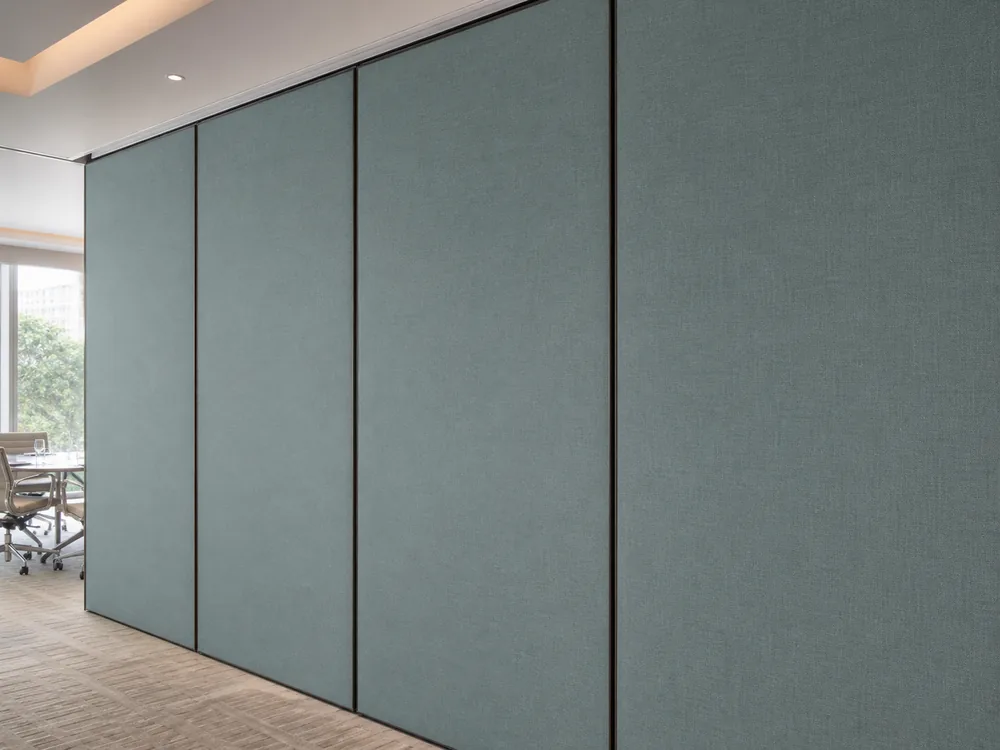
Finish materials can be customized, and cleaning and maintenance methods vary with the selected finish. This means the finish choice and the care routine should be decided together, not separately.
For exhibition halls, different zones may call for different finish approaches. A display wall finish may need a different care method from a finish used on a circulation side. Because care methods vary by finish, the project team should record the intended method for each selected surface.
Exhibition hall partition finishes mobile display walls should be reviewed with the cleaning team before handover planning. The goal is a finish strategy that the hall can maintain consistently over time. The exact route, junction arrangement, continuous overhead path and parking position must be confirmed from the coordinated project drawings.
Non-limiting application examples
Movable partitions can be used wherever flexible space division, combination or reconfiguration is required. Application examples are not limiting. EBUNGE has completed many types of hotel-related movable-partition projects.
Ballrooms, wedding halls and multifunction halls are non-limiting examples. No customer names, locations, quantities, ratings, certifications or outcomes may be inferred from those examples. They simply show the range of settings where movable partitions are considered.
Exhibition hall partition finishes mobile display walls sit within that broader range. The same top-hung principle and the same drawing discipline apply, even when the finish and care plan differ.
Buyer inputs that shape the partition plan
Buyers can prepare several inputs before drawings are coordinated. These inputs help the project team align the partition with the hall rather than treating it as a standalone item.
- The intended partition line and the areas it separates or combines.
- The preferred parking position and the stacking area available.
- The finish direction for panel faces and how it relates to the hall interior.
- The cleaning and maintenance methods expected for each selected finish.
- The layout requirements that may change between events or configurations.
These inputs are planning aids, not final specifications. The exact track, support and panel layout still require project drawings. The exact route, junction arrangement, continuous overhead path and parking position must be confirmed from the coordinated project drawings.
Drawing approvals and coordination
Coordinated drawings are the point where finish, parking and layout decisions come together. Panel parking style can be customized to the customer layout and project requirements, subject to coordinated drawings.
A suitable approved parking arrangement can use the stacking area more compactly and coordinate with the space design. Approval should cover the finish selection and the care method as well as the parking position.
Exhibition hall partition finishes mobile display walls should be reviewed against the drawings before any commitment is made. The exact route, junction arrangement, continuous overhead path and parking position must be confirmed from the coordinated project drawings.
How to review a finish and parking proposal
A structured review helps buyers compare proposals on the same basis. The table below lists review areas and the questions to ask.
| Review area | Question to ask |
|---|---|
| Finish selection | Which finish materials are proposed, and how do they relate to the hall interior? |
| Care method | What cleaning and maintenance method applies to each selected finish? |
| Parking position | Where is the stacking area, and how does it coordinate with the space design? |
| Drawing status | Are the coordinated drawings complete for track, support and panel layout? |
This review does not replace the coordinated drawings. It simply keeps finish and parking decisions visible during the approval process.
Common questions about exhibition hall partition finishes mobile display walls
Does a top-hung movable partition require a floor track?
No. The EBUNGE movable partition system is top-hung and has no continuous floor running track or operating hardware in the finished floor along the partition line. The floor is not cut or damaged for a floor track and remains physically uninterrupted by the maintained EBUNGE top-hung system.
Can finish materials be customized for an exhibition hall?
Yes. Finish materials can be customized, and cleaning and maintenance methods vary with the selected finish. The finish direction should be coordinated with the parking plan and the hall interior.
How is panel parking decided?
Panel parking style can be customized to the customer layout and project requirements, subject to coordinated drawings. A suitable approved parking arrangement can use the stacking area more compactly and coordinate with the space design. The exact track, support and panel layout still require project drawings.
Are movable partitions limited to certain room types?
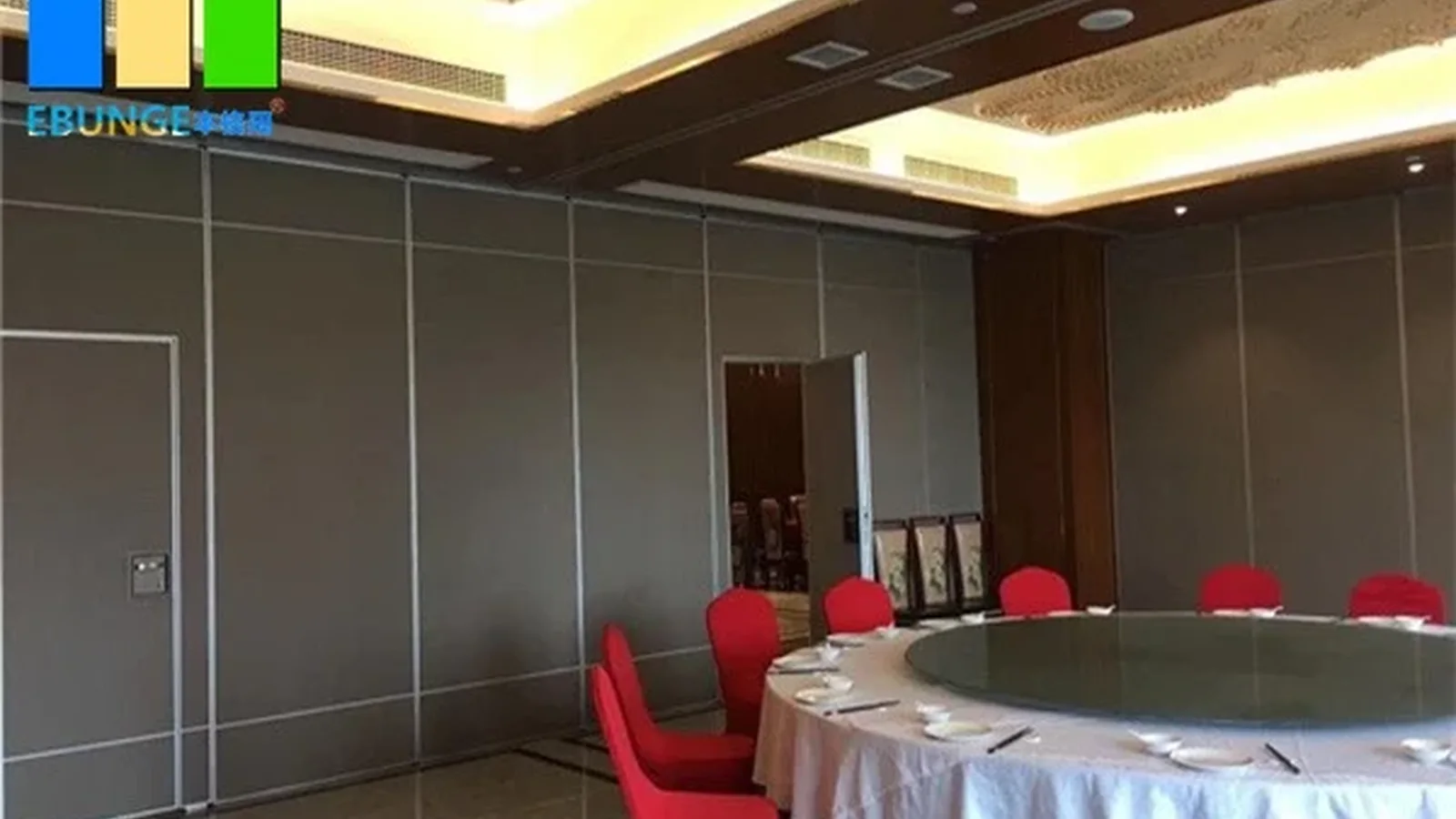
No. Movable partitions can be used wherever flexible space division, combination or reconfiguration is required, and application examples are not limiting. EBUNGE has completed many types of hotel-related movable-partition projects, with ballrooms, wedding halls and multifunction halls as non-limiting examples.
What must be confirmed before approval?
The exact route, junction arrangement, continuous overhead path and parking position must be confirmed from the coordinated project drawings. Finish selection and the related care method should also be recorded for the selected surfaces.
Where to go next
Exhibition hall partition finishes mobile display walls reward early coordination between finish choice, parking planning and drawing approval. Buyers who prepare clear inputs can review proposals on a consistent basis.
To explore the system further, see the movable partition wall page and the projects page. The exact route, junction arrangement, continuous overhead path and parking position must be confirmed from the coordinated project drawings.
Continue Exploring
More Materials and Finishes Guides
- Newer guideExhibition Hall Partition Finish: Trade Show vs Conference Use
- Earlier guideHealthcare Training Partition Finish: UV vs Chemical Cleaning
- Related guideWho Verifies Partition Handover Records When Trades Finish at Different
- Related guideMovable Partition Finish Sample Coordination Guide for Interior