
Quick project answer
Contractor tender handover movable partition is a critical phase where design intent meets site reality. For top-hung movable partitions, the handover must confirm that the overhead track and support strategy align with the building structure and finished floor. This article explains how to coordinate that handover without overstepping confirmed product facts.
Understanding the top-hung principle
The EBUNGE movable partition system is top-hung. It carries panel weight from an overhead track rather than from a floor track. This principle shapes every coordination decision during tender handover.
Because the system is top-hung, there is no continuous floor running track or operating hardware in the finished floor along the partition line. The floor remains physically uninterrupted by the maintained EBUNGE top-hung system.

The exact overhead route and support arrangement must be confirmed by the responsible project team from coordinated drawings. The exact route, junction arrangement, continuous overhead path and parking position must be confirmed from the coordinated project drawings.
Why the floor stays physically uninterrupted
In a top-hung configuration, the floor is not cut or damaged for a floor track. This is a confirmed fact for the maintained EBUNGE system. The finished floor can remain continuous along the partition line.
That continuity matters for handover because flooring trades can complete their work without waiting for a floor track installation. However, the overhead track and its support still require coordination with the structure above.
Contractor tender handover movable partition should therefore focus on the overhead path, not on floor trenching. Any floor penetrations would come from other systems, not from the top-hung partition itself.
Parking planning and stacking area coordination
Panel parking style can be customized to the customer layout and project requirements, subject to coordinated drawings. A suitable approved parking arrangement can use the stacking area more compactly and coordinate with the space design.
The exact track, support and panel layout still require project drawings. During tender handover, the contractor should confirm the parking position and how it relates to adjacent walls, columns, or services.
Parking planning is not a universal sequence. It depends on the specific layout and the coordinated drawings. The handover should record the approved parking arrangement and any interfaces with other trades.
Finish and care coordination
Finish materials can be customized, and cleaning and maintenance methods vary with the selected finish. This means the handover should identify the selected finish and the corresponding care method.
Contractor tender handover movable partition should include a clear record of finish selections so that cleaning teams and facility staff understand the appropriate methods. Different finishes may require different products or techniques.
Do not assume a single cleaning method applies to all finishes. The confirmed fact is that care varies with the finish. The handover documentation should reflect that variability.
Non-limiting applications and project types
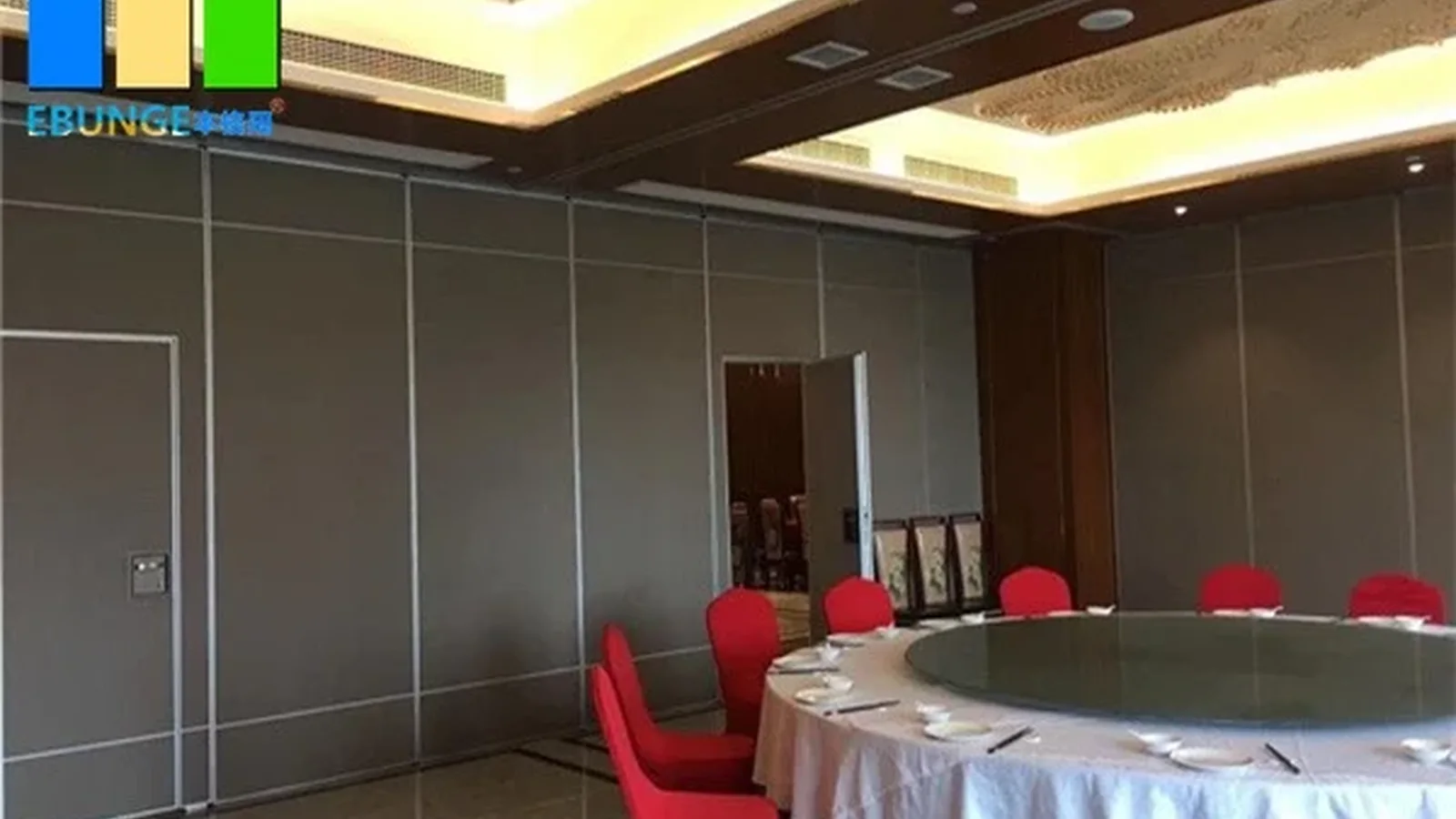
Movable partitions can be used wherever flexible space division, combination or reconfiguration is required. Application examples are not limiting.
EBUNGE has completed many types of hotel-related movable-partition projects. Ballrooms, wedding halls and multifunction halls are non-limiting examples. No customer names, locations, quantities, ratings, certifications or outcomes may be inferred.
Contractor tender handover movable partition for these spaces should still follow the same coordination principles: confirm the overhead path, parking, and finish care from the drawings.
Buyer inputs needed before tender handover
To coordinate the handover, the buyer or main contractor should provide layout drawings, intended use, and any known constraints. These inputs help define the parking area and the overhead route.
The buyer should also confirm finish preferences so that care requirements can be documented. Any changes to layout or finish should be captured before handover.
Without these inputs, the handover cannot be complete. The exact route, junction arrangement, continuous overhead path and parking position must be confirmed from the coordinated project drawings.
Drawing approvals and coordination checkpoints
Drawing approvals are the backbone of contractor tender handover movable partition. The coordinated drawings should show the overhead track route, support locations, and parking position.
Checkpoints include verifying that the floor remains uninterrupted, that parking fits the stacking area, and that finish care is noted. Each checkpoint should be signed off by the relevant parties.
Do not prescribe a universal installation sequence. The handover is about confirming the coordinated drawings, not about dictating a step-by-step method.
Scannable coordination checklist
- Confirm the top-hung principle and that no floor track is required.
- Verify the floor is not cut or damaged for a floor track.
- Review parking style and stacking area against the layout.
- Record finish selections and finish-specific care methods.
- Check that coordinated drawings show the overhead route and parking position.
Common handover questions
Contractor tender handover movable partition is not about a generic sequence. It is about confirming that the coordinated drawings reflect the top-hung system, uninterrupted floor, and approved parking.
FAQ
What does contractor tender handover movable partition involve?
It involves confirming that the coordinated drawings show the top-hung track route, support locations, parking position, and finish care. The handover ensures all parties agree on these elements before work proceeds.
Does a top-hung movable partition require a floor track?
No. The EBUNGE movable partition system is top-hung and has no continuous floor running track or operating hardware in the finished floor along the partition line.
Can the floor be left uninterrupted?
Yes. The floor is not cut or damaged for a floor track and remains physically uninterrupted by the maintained EBUNGE top-hung system.
How is parking planned during handover?
Panel parking style can be customized to the customer layout and project requirements, subject to coordinated drawings. A suitable approved parking arrangement can use the stacking area more compactly and coordinate with the space design.
What about finish and cleaning coordination?
Finish materials can be customized, and cleaning and maintenance methods vary with the selected finish. The handover should record the finish and its specific care method.
Where can movable partitions be used?
Movable partitions can be used wherever flexible space division, combination or reconfiguration is required. Application examples are not limiting.
For product information, see /products/. For project examples, see /projects/.
The exact route, junction arrangement, continuous overhead path and parking position must be confirmed from the coordinated project drawings.
Continue Exploring
More Cost and Planning Guides
- Newer guideContractor Tender Coordination for Partition Stacking Pockets Planning
- Earlier guideOffice Suites Partition Stacking: Door Swings Drawings
- Related guideReview a Movable Partition Tender for Unclear Interface Ownership
- Related guideCompare Movable Partition Tender Returns When Bidders Bundle