
html body.single-post main#content.site-main{box-sizing:border-box!important;width:calc(100% – 32px)!important;max-width:900px!important;margin-left:auto!important;margin-right:auto!important;padding-left:0!important;padding-right:0!important}
Quick answer: movable partition tender
Review focus: movable partition tender.
Movable partition tender interface scope scoring becomes difficult when bidders price the panels but leave the surrounding interfaces vague. The tender may look complete because a finish and a panel count are listed, yet the return does not explain how the system meets the structure, how panels travel, where they park, or who confirms the opening dimensions. This article offers an evidence-bounded framework for scoring those returns without inventing performance, engineering conclusions or commercial outcomes.
Why Interface Scope Disappears From Tender Returns
Project review term: movable partition tender.
Interface scope is the work and information that connect the movable partition to the building. It includes the overhead support condition, the route the panels follow, the parking position, and the documentation that confirms dimensions and finishes. Bidders often omit these items because they are not a single product line item. A return may show a panel type and a finish, but not the coordinated route or the stacking location.
For scoring, treat an omitted interface as a clarification item, not an automatic failure. The goal is to compare what each bidder has actually confirmed and what remains open. The suitability of each route and parking arrangement depends on the approved layout, circulation, ceiling interfaces and operating sequence.
Build a Scoring Sheet Around Confirmed Information
Coordination scope: movable partition tender.
Start with a scoring sheet that separates confirmed facts from open questions. Confirmed facts are statements the bidder has supported with drawings, schedules or written descriptions. Open questions are items that need project-specific confirmation. Do not award points for implied performance or for a finish photograph that does not address the interface.
- Route clarity: Does the return describe the straight, turning and stacking routes from the layout?
- Overhead support: Does it identify the support condition that must be reviewed by the project team?
- Parking position: Is the planned stacking position shown or described?
- Finish scope: Are laminate, melamine, fabric, leather, glass or other approved surfaces listed for the correct areas?
- Pass-door needs: Are pass-door requirements discussed where the layout calls for them?
- Documentation: Does the bidder state what project documentation will be provided and what remains to be confirmed?
This checklist does not replace a full tender review. It gives evaluators a consistent way to see which returns address the interface and which returns leave it to others.
Score the Movement Route Before the Finish
Checklist focus: movable partition tender.
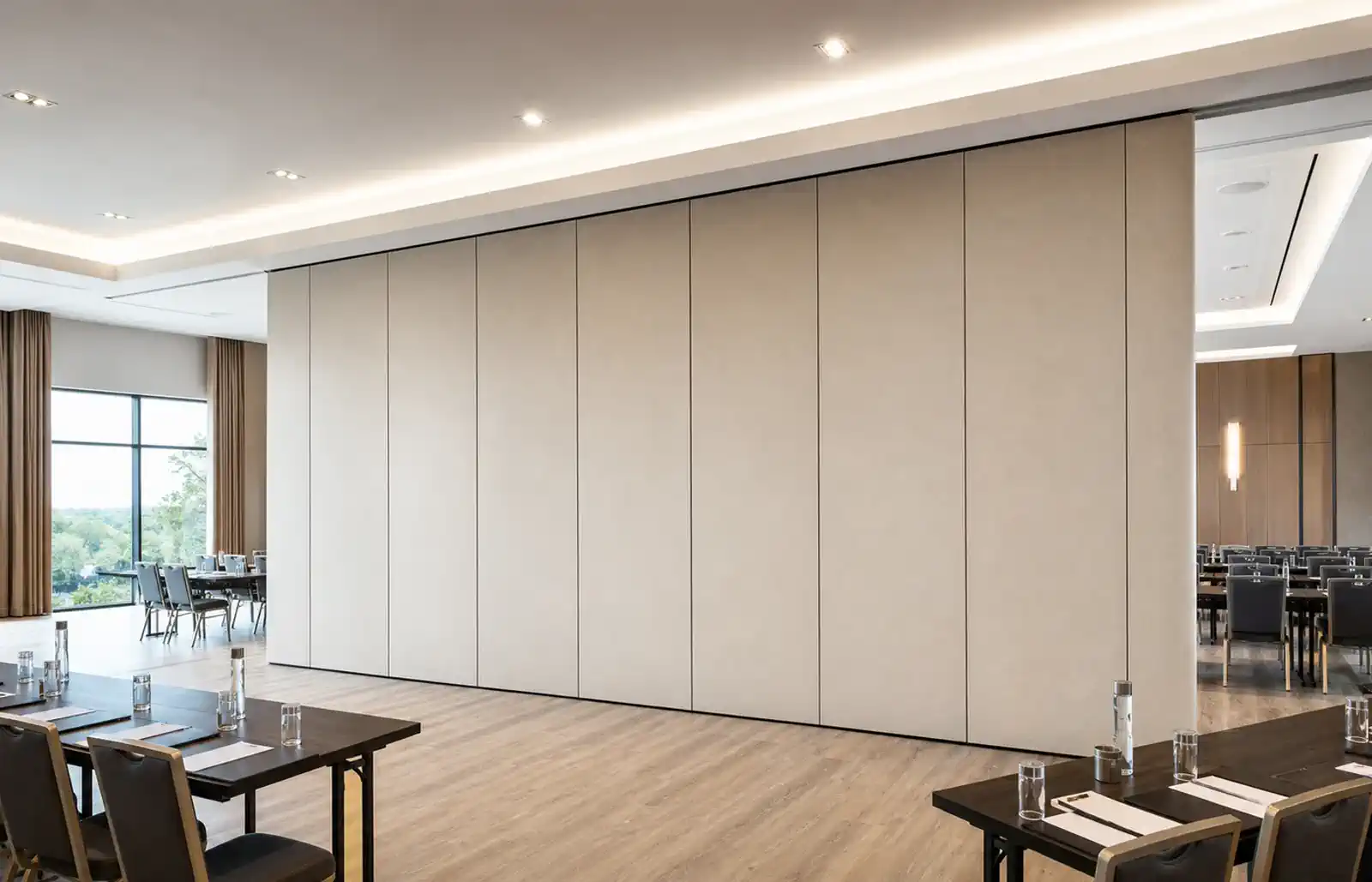
Movable partition panels are individually movable, suspended from a top track, cross the opening without a floor track, and park at a planned stacking position. That maintained product fact makes the movement route a central scoring item. A return that lists finishes but does not show how panels move from the closed position to the parking position has not addressed the interface.
Ask bidders to mark the straight, turning and stacking routes on the layout. The exact route, junction arrangement, continuous overhead path and parking position must be confirmed from the coordinated project drawings. Do not infer that panels can travel across an unsupported gap. The scoring question is whether the return shows a connected route that the project team can review.

Route evidence note
Score route clarity only from the layout and written description supplied in the return. A route that is not drawn or described remains an open question, even if the panel count and finish schedule look complete.
Compare Omissions With a Compact Matrix
Review focus: movable partition tender.
A compact matrix helps evaluators compare returns without turning the exercise into a search for hidden performance. Use the same categories for every bidder and record whether each item is confirmed, partially addressed or not addressed. The matrix below is a scoring aid, not a statement about any product or project.
| Interface item | Confirmed | Partially addressed | Not addressed |
|---|---|---|---|
| Straight, turning and stacking routes | Routes shown on layout | Route described in text only | No route information |
| Overhead support review | Support condition identified for review | General note without location | Not mentioned |
| Parking position | Stacking position shown | Position described generally | Not mentioned |
| Finish schedule | Approved surfaces listed by area | Some areas listed | Finish not scheduled |
| Pass-door requirements | Discussed where needed | Raised as a question | Not mentioned |
| Project documentation | Document list stated | Partial list stated | No documentation scope |

Use the matrix to identify clarification questions, not to declare a winner. A return that is strong on finishes but silent on routes may still be workable if the bidder can confirm the missing interface before award.
Ask Clarification Questions That Produce Evidence
Project review term: movable partition tender.
Clarification questions should ask for evidence, not for reassurance. Instead of asking whether the system will work, ask the bidder to mark the route on the layout, identify the support condition that requires project review, and state the parking position. Ask which finish options are proposed for each area and whether pass-door requirements have been considered.
Ask the bidder to state what project-specific acoustic documentation will be provided and what remains to be confirmed by the project team.
Numbered clarification process
- Issue a written clarification request that lists each omitted interface item.
- Ask for marked-up drawings showing straight, turning and stacking routes.
- Request a written statement of the overhead support condition to be reviewed by the project team.
- Confirm the planned parking position and any space implications shown on the layout.
- Confirm finish options by area and note any pass-door requirements.
- Record the documentation the bidder will provide and the items that remain project-specific.
Keep Acoustic and Dimensional Claims Inside Evidence Limits
Coordination scope: movable partition tender.
Acoustic and dimensional claims are common sources of overreach in tender returns. A bidder may state a rating without explaining the test condition, the opening size or the interface details that affect the result. For scoring, reward returns that separate confirmed information from items requiring project-specific confirmation.
Dimensional requirements should be checked against the actual opening, the planned route and the parking position. Do not assume that a panel size shown in a brochure will fit every layout. Ask the bidder to confirm dimensions against the project drawings and to identify any condition that needs further review.
Document the Boundary Between Bid and Project Confirmation
A strong tender return states what is included and what must be confirmed later. That boundary protects both the buyer and the bidder. It also makes scoring more consistent because evaluators can see which items are supported by evidence and which are still open.
Use the return to build a short confirmation register. The register should list the interface items that remain open, the party responsible for confirming them, and the drawing or document that will be used. This is not a substitute for professional review, but it keeps the tender evaluation grounded in visible information.
Frequently Asked Questions
What is movable partition tender interface scope scoring?
It is a structured way to evaluate tender returns by checking whether bidders have addressed the interfaces around the movable partition, such as routes, parking, support review, finishes and documentation. It focuses on confirmed information rather than implied performance.
Should a bidder be penalized for omitting interface scope?
Not automatically. An omission is a clarification item. The evaluator should ask the bidder to confirm the missing interface before deciding how it affects the score.
How should routes and parking be scored?
Score them from the layout and written description. The return should show or describe the straight, turning and stacking routes and the planned parking position. The exact route, junction arrangement, continuous overhead path and parking position must be confirmed from the coordinated project drawings.
Can a finish photograph prove acoustic performance?
No. Visible references can support layout discussion but do not verify hidden construction or performance.
What documentation should be requested?
Request the drawings, schedules and written statements that confirm the interface items in the return. The exact documentation depends on the project and should be confirmed with the project team.
When should the project team confirm support and dimensions?
Support and dimensional requirements should be confirmed during the tender review and before award, using the project drawings and the bidder’s marked-up route information.
Conclusion and Next Step
Use a consistent checklist, compare routes and parking against the layout, and keep acoustic and dimensional claims inside their evidence limits. Confirm project-specific support, acoustic and dimensional requirements with the project team before making a final decision.
To discuss pass-door requirements, finish options or project documentation for your layout, contact EBUNGE. You can also review the movable partition wall range and see related project references for planning context.
Continue Exploring
More Cost and Planning Guides
- Newer guideWeight Interface Risk When Scoring Movable Partition Tender
- Earlier guideRedline Movable Partition Tender Specs Before Pricing
- Related guideReview a Movable Partition Tender for Unclear Interface Ownership
- Related guideCompare Movable Partition Tender Returns When Bidders Bundle