
html body.single-post main#content.site-main{box-sizing:border-box!important;width:calc(100% – 32px)!important;max-width:900px!important;margin-left:auto!important;margin-right:auto!important;padding-left:0!important;padding-right:0!important}
Quick answer: movable partition
A movable partition tender stacking pocket allowance audit is a document comparison exercise, not a guess about how much space a system will need. When drawings, specifications and quotations describe the parking area differently, bids stop being comparable. The goal is to find every place where the stacking pocket is described, then confirm that each description refers to the same layout, route and scope. This guide sets out a repeatable review method for contractors, architects, interior designers, owners and procurement teams working on overseas projects.
Why Stacking Pocket Allowances Drift Between Tender Documents
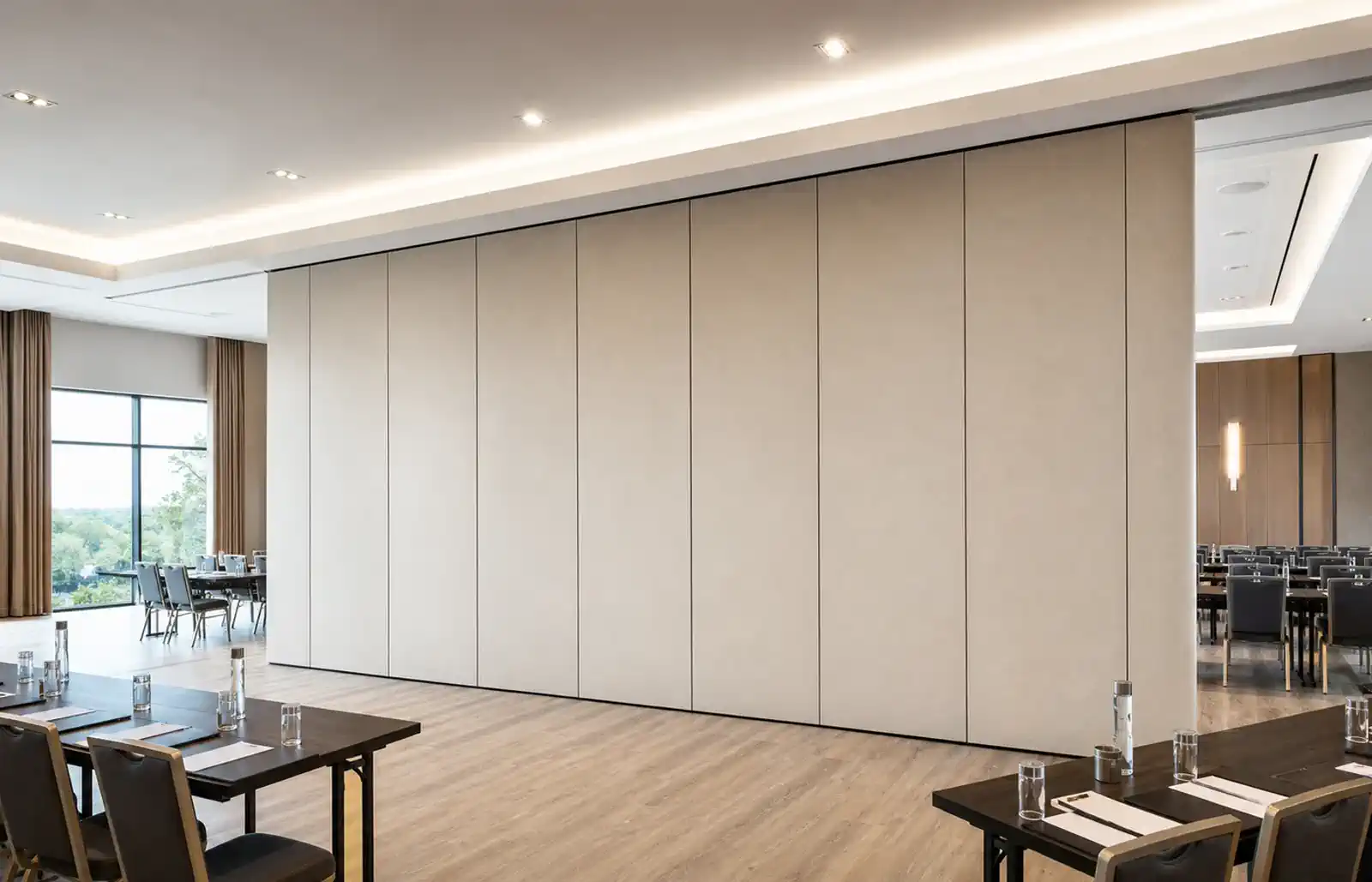
Movable partition panels are individually movable and suspended from a top track. They cross the opening without a floor track and park at a planned stacking position. That parking position is a design decision, so it can be described in several places: architectural plans, partition specifications, finish schedules and supplier quotations.
Inconsistency usually appears when one document is updated and another is not. A pocket may be drawn at one size, described in text at another, and priced against a third assumption. None of these is necessarily wrong, but the tender becomes ambiguous.
Evidence note: this article explains how to compare documents. It does not state a standard pocket size, because the required allowance depends on the confirmed layout, panel arrangement and project-specific review.
Build a Single Source of Truth Before Comparing Bids
Start by collecting every tender document that mentions the partition, the opening, the parking position or the adjacent construction. Mark the revision date on each. Where two documents conflict, record the conflict rather than choosing a winner.
- Architectural floor plans showing the opening and the intended parking location.
- Reflected ceiling plans and any overhead structure near the track route.
- The partition specification and finish schedule.
- Supplier quotations, including any stated exclusions.
- Site or coordination notes that affect the pocket area.
This register becomes the reference for the rest of the audit. It also gives bidders the same starting point when clarifications are issued.
A Six-Step Audit Process for the Tender Team
- Locate every mention. Search drawings and text for the parking position, pocket, recess and stacking area.
- Trace the route. Confirm whether the proposed path is straight, turning or a combination, and whether it ends at the planned stacking position.
- Check the overhead route. Panels are suspended from a top track, so the route must be continuous and connected. The exact route, junction arrangement, continuous overhead path and parking position must be confirmed from the coordinated project drawings.
- Compare the pocket description. Note differences in position, orientation and how the parked panels are shown.
- Review scope boundaries. Identify who is responsible for the pocket opening, adjacent walls, finishes and any builder’s work implied by the drawings.
- Issue one clarification list. Send the same questions to every bidder so responses can be compared fairly.

Keep the clarification list factual. Ask what the bidder has assumed, rather than asking for a promise about performance or outcomes.
Compare Tender Returns on the Same Basis
Once returns arrive, compare them line by line against the register. The table below shows a simple way to record differences without inventing values.
| Audit item | What to record | Why it matters |
|---|---|---|
| Parking location | Where each document places the stacked panels | Reveals layout conflicts early |
| Route type | Straight, turning or mixed, as drawn | Confirms the movement path is described consistently |
| Pocket responsibility | Which party owns the adjacent construction | Prevents duplicated or missing scope |
| Finish assumptions | Laminate, melamine, fabric, leather, glass or other approved surface | Keeps finish pricing comparable |
| Pass-door needs | Whether a pass door is required and where | Avoids late changes to the layout |
Where a bidder has priced a different pocket arrangement, ask for a revised return against the common register. Do not adjust one bid silently to match another.
Coordinate the Pocket With Adjacent Trades
The stacking pocket is rarely a partition-only issue. It sits next to walls, ceilings, finishes and sometimes services. The suitability of each route and parking arrangement depends on the approved layout, circulation, ceiling interfaces and operating sequence.
Bring the relevant trades into the review before the tender is awarded. Ask each to confirm what they have assumed about the pocket area. Record those assumptions in the same register so the successful bidder and the site team work from one description.
For product context, review the movable partition wall page and compare it with the tender documents. Where the tender includes a pass door or specific documentation requirements, raise these as clarification items rather than assuming a standard answer.
Know What the Tender Cannot Tell You
A tender review can confirm consistency of description.
Seals and acoustic concepts can be discussed generically, but the actual configuration must be confirmed for the project. Similarly, the tender should not be read as evidence of service life, maintenance outcomes or financial return.
- Visible references can support layout discussion but do not verify hidden construction or performance.
- Confirm dimensional requirements against reviewed drawings.
- Confirm support and fixing requirements through project-specific review.
- Confirm finish suitability for the intended space.
Close the Audit With a Clear Award Basis

Finish by issuing a short audit summary: the agreed parking position, the route as drawn, the scope split, the finish basis and the open clarifications. Attach it to the tender report so the award decision is traceable.
If the project moves forward, share the same summary with the site team. Reviewing similar project references can help frame questions, but each new project still needs its own drawing review and confirmation.
Frequently Asked Questions
What is a stacking pocket allowance in a movable partition tender?
It is the space described in the tender documents where panels park when the opening is clear. The allowance must match the confirmed layout and route, so it should be described consistently across drawings, specifications and quotations.
Can I use one standard pocket size for every project?
No. The required allowance depends on the confirmed layout, panel arrangement and project-specific review. Treat any single figure as an assumption to be verified, not a default.
Do movable partitions need a floor track along the opening?
EBUNGE movable partition panels are top-hung and cross the opening without a floor track.
How should turning routes be handled in the audit?
Straight, turning and stacking routes are reviewed from the layout. Record the route type as drawn and check that every document describes the same path to the same parking position.
What if bidders describe the pocket differently?
Do not adjust bids silently. Issue one clarification list to all bidders and ask each to confirm assumptions against the common register, then compare the revised returns.
Can the tender confirm acoustic performance?
No. Acoustic requirements need project-specific evidence.
Conclusion and Next Step
A disciplined movable partition tender stacking pocket allowance audit protects the comparison process. It keeps every bidder working from the same layout, route and scope, and it separates what the documents say from what still needs confirmation. Start with the register, trace the route, compare returns on one basis and record open items clearly.
To discuss pass-door requirements, project documentation or a specific layout, contact the EBUNGE team with your drawings and tender questions.
Continue Exploring
More Cost and Planning Guides
- Earlier guideWhat a Tender Evaluation Matrix Should Score on Partition Bids
- Related guidePlan a Partition Reconfiguration Calendar Around Facility Budget Cycles
- Related guideCheck a Movable Partition Tender for Inconsistent Unit Rates
- Related guideBuild a Tender Clarification Question Bank for Partition Packages