
When planning flexible performance spaces in universities, the comparison of university auditorium partition seals speaker baffles comparison often arises. The suitability of each route and parking arrangement depends on the approved layout, circulation, ceiling interfaces and operating sequence. This article provides an evidence-bounded framework for comparing these elements, emphasizing that every decision must be confirmed with project-specific drawings and support reviews.
Understanding the Role of Partition Seals in Auditorium Flexibility
Movable partitions allow auditoriums to be subdivided for lectures, rehearsals, or events. The sealing system is crucial for controlling sound flanking paths—the indirect routes sound can travel around or through the partition.
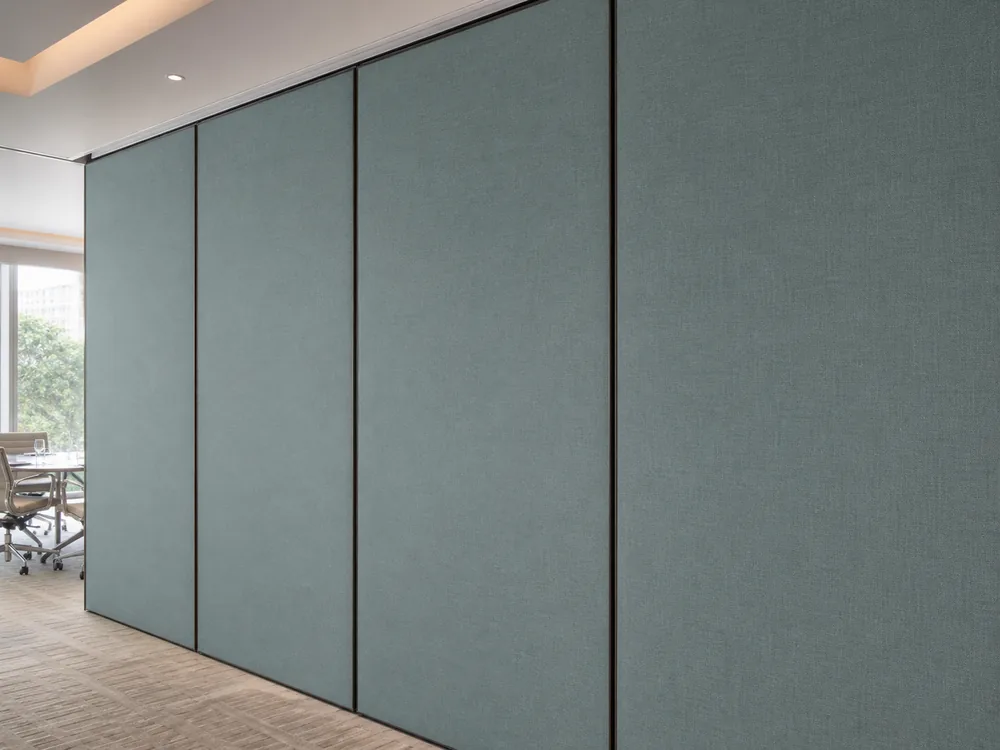
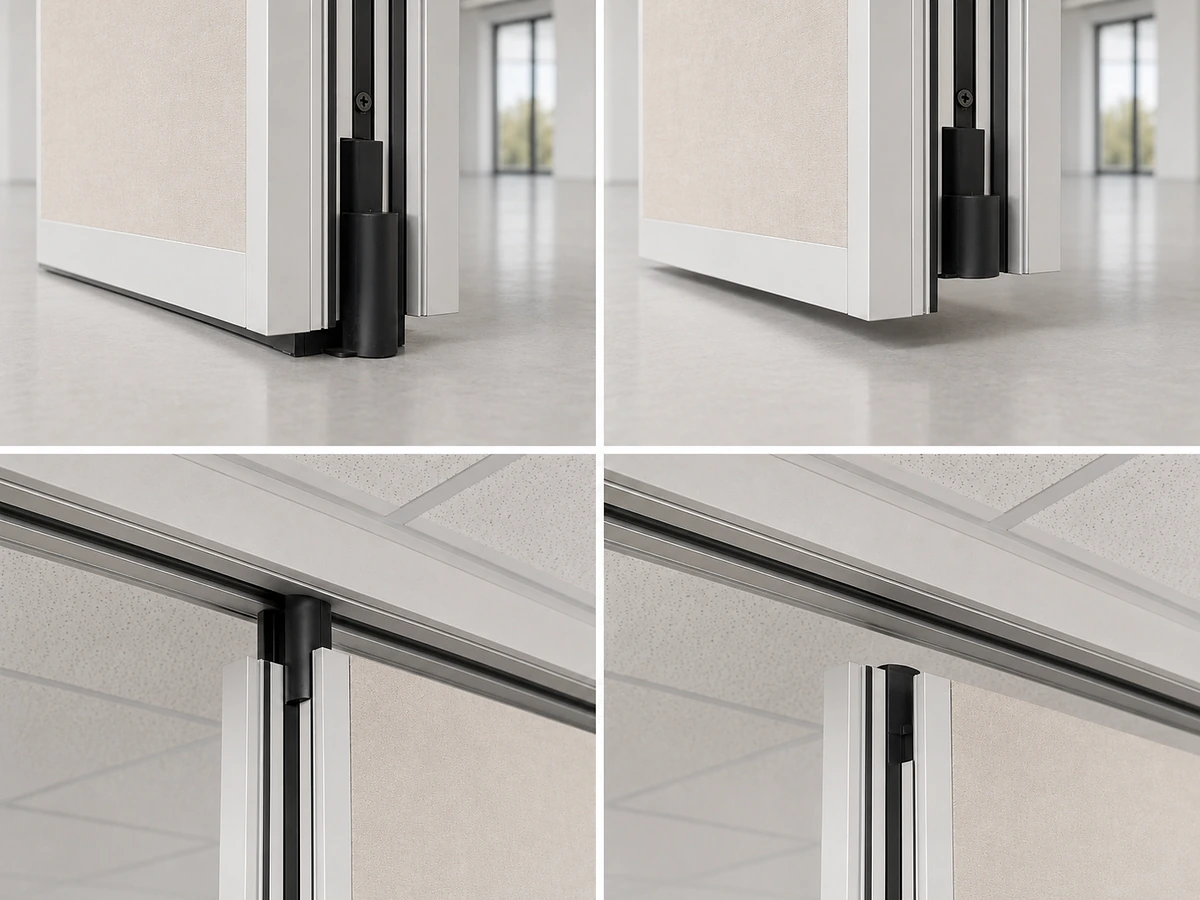
EBUNGE movable partition panels are top-hung and move without a continuous floor running track or floor hardware along the partition line. This design simplifies floor transitions but requires careful coordination with overhead tracks and stacking areas.
Key Differences Between Wall-Mounted Speaker Baffles and Acoustic Panels
Their purposes differ: baffles manage speaker projection and protection, whereas panels control reverberation and echo. In an auditorium, both may be present, but they affect partition seals differently.
Speaker Baffles: Structural and Alignment Challenges
Speaker baffles often protrude from the wall, creating irregular surfaces that can interrupt the continuous sealing line. If a partition must seal against a wall with a baffle, the seal must accommodate the baffle’s shape and depth. This requires precise dimensional coordination to ensure the partition can still achieve a tight closure.
Acoustic Panels: Surface and Finish Interactions
Share the opening dimensions, room layout and intended operating sequence for review.
Their porous surfaces can affect seal adhesion and durability. EBUNGE offers finish options including laminate, melamine, fabric, leather, glass, and other approved surfaces, but these are for the partition itself, not the adjacent wall treatment.
How Sealing Works in Movable Partitions: A Conceptual Overview
Seals in movable partitions are designed to block air gaps that transmit sound. They are typically compressed when the partition is closed, creating a barrier. The performance of seals is influenced by the stiffness of the surrounding structure, the flatness of the sealing surface, and the continuity of the seal path.
For EBUNGE partitions, the sealing system is part of the overall partition design. The panels are individually movable and suspended from a top track, crossing the opening without a floor track. This means the bottom seal must be effective without a floor guide, relying on the panel’s weight and sealing mechanisms. The top and side seals interact with the building structure, including any wall-mounted elements.
Critical Coordination Points for Auditorium Projects
These are not exhaustive but highlight where evidence is required.
Continuous Overhead Track Routes
Every proposed movement path for the partition requires a continuous connected overhead route. The layout must be reviewed to ensure straight, turning, and stacking routes are feasible. EBUNGE reviews these routes from the layout, but the final design must be confirmed with project-specific drawings.
Stacking and Parking Configurations
Parking style is customized to the customer layout and project requirements. For example, if panels stack against a wall with a protruding baffle, the stacking depth must accommodate the baffle’s projection. This requires dimensional coordination.
Sealing Surface Flatness and Material
The surface against which the partition seals must be flat and rigid enough to support seal compression. Both can compromise seal effectiveness if not properly detailed. The project team must confirm that the sealing surface is suitable for the partition’s sealing system.
Comparing Speaker Baffles vs Acoustic Panels: A Decision Framework
Impact on Seal Continuity
Speaker baffles, due to their protrusions, are more likely to interrupt the seal line. However, the panel’s material must be compatible with seal contact. For example, a fabric-wrapped panel may be too soft for a tight seal.
Acoustic Performance Objectives
Structural and Dimensional Coordination
Both must be detailed in the construction documents.
Review the ceiling interface, panel route and stacking position together.
Project Documentation and Evidence Requirements
Every comparison must be grounded in project-specific evidence.
What to Confirm with EBUNGE
Provide detailed drawings showing the partition’s track route, stacking area, and any wall-mounted elements. Visible references can support layout discussion but do not verify hidden construction or performance.
Boundaries of Unsupported Claims
Do not assume that a particular seal design will achieve a specific STC/Rw rating without test data. They are determined through standardized tests. Without such tests, you cannot claim a specific rating.
FAQ: Common Questions About Partition Seals and Wall-Mounted Elements
Can a movable partition seal effectively against a wall with a speaker baffle?
It depends on the baffle’s shape and the partition’s sealing system. The sealing surface must be flat and rigid. If the baffle protrudes, a custom seal or transition piece may be needed. This requires project-specific engineering review.
Are acoustic panels better than speaker baffles for partition sealing?
Not necessarily. Speaker baffles may require more complex detailing.
What information do I need to provide to EBUNGE for a partition layout review?
Also include details about the ceiling structure and floor conditions. EBUNGE can then review the layout and discuss options.
How do I know if a partition will achieve a certain acoustic rating?
You cannot infer them from the partition’s appearance or seal design. To know the rating, you must refer to test reports for the specific partition configuration, or conduct tests on your project.

Can EBUNGE partitions be used in rooms with wall-mounted speaker baffles?
Yes, EBUNGE partitions can be used in such spaces, but the layout must be coordinated to ensure the partition’s movement and sealing are not obstructed. The project team must confirm that the overhead track route is continuous and that the stacking area is clear.
Conclusion: Making an Evidence-Based Comparison
EBUNGE movable partitions offer flexibility with top-hung, floor-track-free designs, but every application must be reviewed for support and dimensional requirements.
To move forward, contact EBUNGE with your project drawings. Our team can discuss your layout, pass-door needs, and documentation. .
Continue Exploring
More Acoustic Partition Guides
- Newer guideWhy Conference Venue Partition Seals Need Interface Detailing at Wall-Mounted Speaker Baffles
- Earlier guideWhy School Auditorium Partition Seals Need Interface Detailing at Wall-Mounted Sound Meter Displays
- Related guideHow to Coordinate Office Meeting Suite Partition Seals with Wall-Mounted Video Bar Swing Paths
- Related guideHow to Coordinate Hotel Banquet Partition Seals with Ceiling-Mounted Rigging Point Access Panels