
html body.single-post main#content.site-main{box-sizing:border-box!important;width:calc(100% – 32px)!important;max-width:900px!important;margin-left:auto!important;margin-right:auto!important;padding-left:0!important;padding-right:0!important}
Quick answer: movable partition tender
Review focus: movable partition tender.
A movable partition tender interface assumptions review is not a line-by-line price check. It is a structured reading of what the documents assume about structure, routes, stacking, finishes and coordination. Hidden assumptions usually sit in drawing notes, schedules and specification clauses rather than in the headline scope. The suitability of each route and parking arrangement depends on the approved layout, circulation, ceiling interfaces and operating sequence. This article offers an evidence-bounded framework.
Why Interface Assumptions Hide in Plain Sight
Project review term: movable partition tender.
Tender packages are assembled from many sources. When those descriptions are read separately, gaps appear. A ceiling plan may show a track line without confirming the supporting structure above. A finish schedule may name a surface without confirming the substrate or edge detail.
The risk is not only commercial. An unstated assumption can shift responsibility between trades. A contractor may price a route that later proves impossible because the overhead path is interrupted. An architect may assume a parking position that conflicts with a door swing or a services riser. A review that names these interfaces early keeps the conversation factual.
Start With the Movement Story, Not the Panel
Coordination scope: movable partition tender.
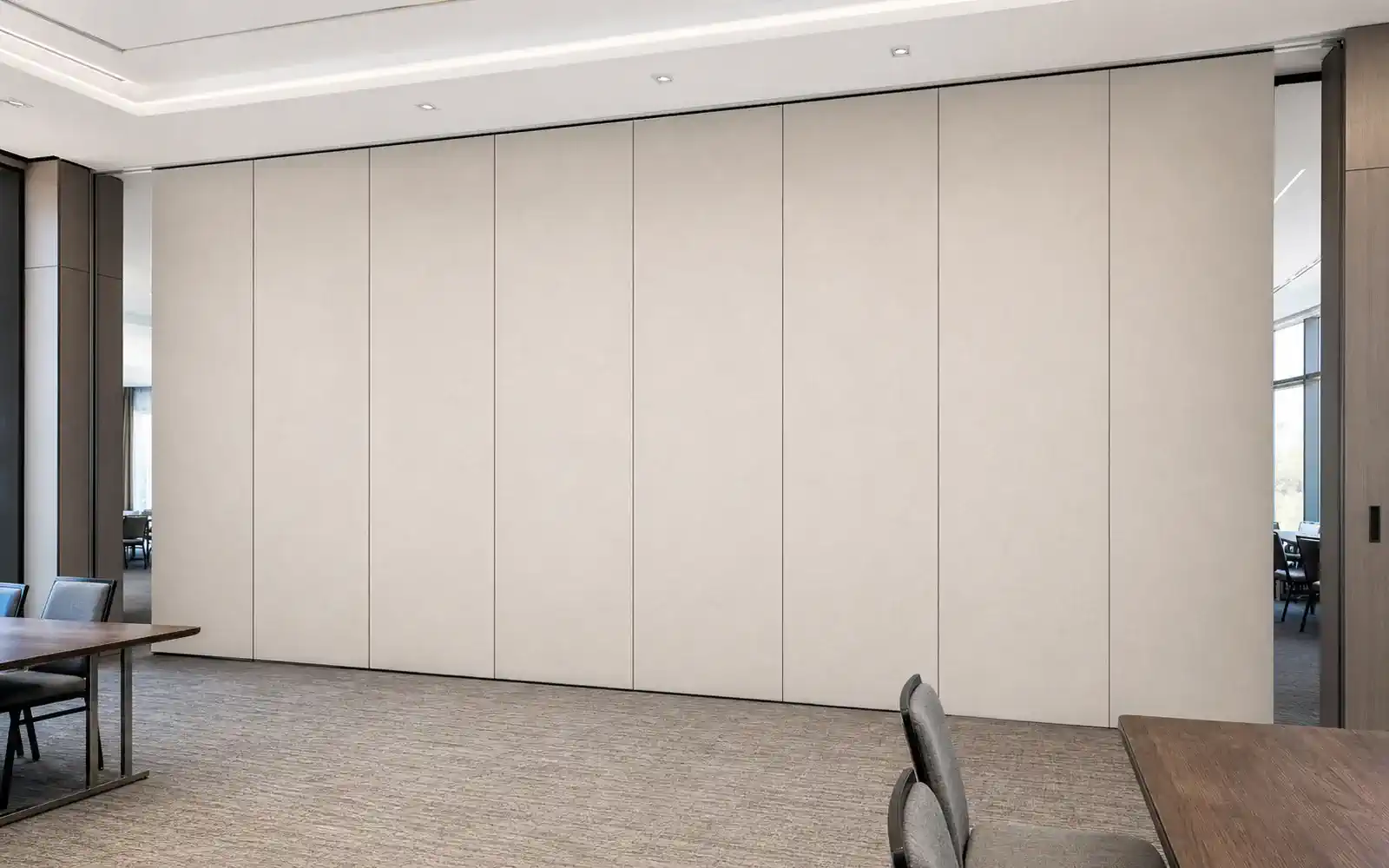
EBUNGE movable wall panels are individually movable, suspended from a top track, cross the opening without a floor track, and park at a planned stacking position. That maintained description is the starting point for reading any tender. The tender should explain how each panel travels from its closed position to its parking position, and what happens along that route.
Straight, turning and stacking routes are reviewed from the layout. If the drawings show only a closed partition line, the movement story is incomplete. Ask for a plan that traces the full path, including any turning condition and the final stacking location. Do not infer a route from a photograph or a typical detail.
Questions That Reveal the Route Assumption
- Does the tender show a continuous connected overhead route for every proposed movement path?
- Is the parking position drawn to scale, and does it clear adjacent doors, services or finishes?
- Are turning conditions shown, or only a straight run?
- Does the ceiling plan confirm the supporting structure along the entire route?
Reading the Overhead Support Interface
Checklist focus: movable partition tender.
Because the panels are top-hung, the overhead support interface is central. The tender should identify who confirms the supporting structure and what information that confirmation requires. This is a project-specific engineering matter. It cannot be resolved by a generic note such as “support by others” without a defined scope.

A useful review separates three items: the track line, the supporting structure above it, and the coordination responsibility between them. If any of the three is missing, the tender carries a hidden assumption. The same applies to the parking zone, where panels gather when the opening is clear.
Evidence Note: What a Drawing Can and Cannot Show
A drawing can show a proposed track line, a parking zone and a movement route. It cannot, by itself, confirm structural capacity, acoustic performance, fire performance or installation feasibility. Those require project-specific confirmation with the responsible disciplines.
Finish Schedules and Surface Assumptions
Review focus: movable partition tender.
Confirmed finish options include laminate, melamine, fabric, leather, glass and other approved surfaces. A tender may list a finish without explaining how it relates to the surrounding interior. The review should check whether the finish schedule matches the architectural intent and whether any special edge or junction condition is described.
Do not treat a finish name as evidence of cleaning compatibility, durability or acoustic behaviour. Those are separate questions. If the tender implies a performance outcome from a surface choice, mark it for clarification rather than accepting it.
Pass Doors, Seals and Acoustic Language
Pass-door requirements and project documentation can be discussed with the supplier. In a tender, the pass door is an interface because it affects the panel layout, the movement route and the closed condition. The review should confirm whether a pass door is required, where it sits and how it interacts with the stacking plan.
Seals, junctions and adjacent construction all influence the outcome. The tender should state the required acoustic intent and the evidence expected, not a promise.
Decision Checklist for Tender Clarification
| Interface | What to Confirm | Hidden Assumption to Challenge |
|---|---|---|
| Overhead route | Continuous connected path and supporting structure | That a drawn line is buildable |
| Parking | Location, size and clearance | That any spare space will work |
| Finishes | Approved surface and junction detail | That a finish name implies performance |
| Pass door | Need, position and interaction with stacking | That it can be added later without change |
| Acoustic intent | Required rating system and evidence route | That one number covers the assembly |
Coordinating Procurement and Tender Review
A single clarification round can cover the route, the support, the parking zone, the finish schedule and the pass door. This reduces the chance that one answer contradicts another.
Keep a written query log. Record what was asked, what was answered and what remains open. When an answer depends on a drawing revision, note the revision number. This discipline protects both the buyer and the supplier during later coordination.
Numbered Process for a Structured Review
- Collect all documents that mention the partition, including notes and schedules.
- Trace the movement story from closed position to parking position.
- Mark every point where the overhead route or support is not confirmed.
- Check the finish schedule against the architectural intent.
- Confirm pass-door need and its effect on the layout.
- State the acoustic intent and the evidence expected.
- Issue one consolidated clarification list and log the responses.
What to Confirm Before Pricing
Before pricing, the project team should confirm the layout, the movement route, the parking position, the finish selection and any pass-door requirement. Dimensional and support requirements must be confirmed for the specific project. A tender that leaves these open is not necessarily wrong, but it carries assumptions that should be named.
For product context, see the movable partition wall page. For examples of how flexible space is planned, review the projects section. When the interface questions are ready, contact the team to discuss documentation and project-specific confirmation.
Frequently Asked Questions
What is a movable partition tender interface assumptions review?
The exact overhead route and support arrangement must be confirmed by the responsible project team from coordinated drawings. It helps teams ask precise questions before procurement.
Does a top-hung partition need a floor track?
EBUNGE movable wall panels are suspended from a top track and cross the opening without a floor track. The exact route, junction arrangement, continuous overhead path and parking position must be confirmed from the coordinated project drawings.
Can the tender specify a finish without confirming performance?
Yes. A finish name such as laminate, melamine, fabric, leather or glass describes a surface option. It does not by itself confirm acoustic, fire, durability or cleaning performance. Those require separate project-specific evidence.
How should acoustic requirements be written in a tender?
State the required rating system and the evidence expected. The real outcome depends on the full assembly, including junctions and adjacent construction.
What if the drawings show only a closed partition line?
Ask for the movement story. Straight, turning and stacking routes are reviewed from the layout. Without a traced route and parking position, the tender carries a hidden assumption.
Who confirms the supporting structure above the track?
This is a project-specific engineering matter. The tender should identify the responsible discipline and the information required. A generic note is not a confirmation.
Conclusion and Next Step
A movable partition tender interface assumptions review is a practical habit, not a one-off task. Read the movement story, challenge unstated support and parking assumptions, separate finish names from performance claims, and keep acoustic language tied to evidence. Confirm project-specific support, acoustic and dimensional requirements with the responsible disciplines before committing.
If your team is preparing a tender or comparing submissions, contact EBUNGE to discuss pass-door requirements, project documentation and the interface questions that still need answers.
Continue Exploring
More Cost and Planning Guides
- Earlier guideReview a Movable Partition Tender for Unclear Interface Ownership
- Related guideCompare Movable Partition Tender Returns When Bidders Bundle
- Related guideReview Movable Partition Wall Tender Addenda for Scope Creep
- Related guideMovable Partition Tender Omitted Interface Scope Audit